Tuesday, October 23, 2012

It's Halloween...Time for Some Spooky Science Fun


It's Halloween time...the perfect time for some mysterious science investigations.
Third graders spend time learning all about Matter.  I love this unit and wish I could spend more time digging deeper into the content, but it is already on to the next unit.  Here are some of the activities we covered recently.
 
I like to start all my science units with some sort of read aloud or poem.
I lucked out and stumbled across a poem all about this science topic.
It's called "What's the Matter" and it gives examples and defines matter within the poem.
We glued it into our poetry anthology after working with it during shared reading time.


We are lucky to have many books on this science topic in our school library.  Here are some good ones.  Students are able to take these to read during readers workshop time.
 This is one of my favorites...
 After exposing them to the topic and reading about it in our science book, we created a folder to keep our Matter information sheets and science lab reports.
I love how this student decorated hers with key words like: volume and mass.
 Now that we had a general idea of what matter was, it was time to start working with it. Our first hands on investigation was simply to test whether objects had mass and volume.  This gave students the opportunity to work with balance scales and measuring cups and explore the idea of weight and capacity.
 Through this experiment students proved a rock has volume.  It took up space within the measuring cup causing the water level to rise.
 After learning what matter was, we were on to learning about how physical properties or characteristics of matter may change.  Here was an example of a dramatic change.  We took bars of ivory soap and examined them, noting their physical properties like size,shape, color, texture, etc.  
 Here is a student recording those observations and drawing a scientific illustration of what he noticed.
 Then we microwaved the soap for a minute and watched it expand and change shape and texture!!
The kids were amazed!
 
Here is another great experiment on physical changes that I did last year.   This one involves gummy candy and water. I plan on doing this one with Halloween gummies next week as we celebrate that holiday with some fun learning experiences.
Again, students observed the gummy on day one and recorded the physical properties. Then
students placed a gummy into a tiny cup of water and left it there overnight. 
                                  
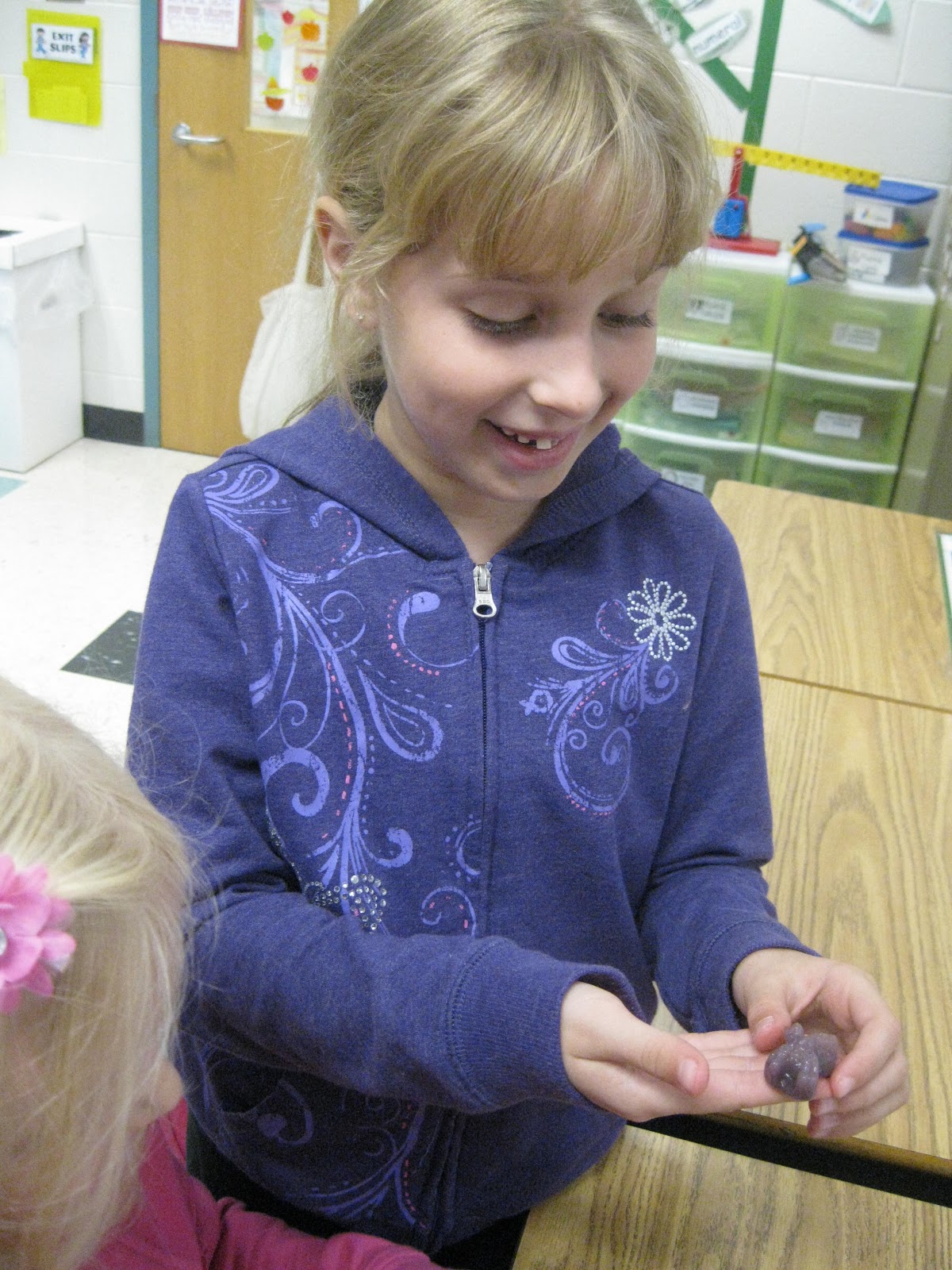
 The next day we checked our cups and the gummy had doubled, some had tripled in size!  A great physical change!
 
Look at the size of that gummy! 
 
Good scientists always record!  Here is an example of the lab report we used.

We are not supposed to have an official Halloween celebration next Wednesday but how can we just ignore it?  My plan is to sneak some Halloween into another experiment involving the states of matter when we make a special brew with ingredients that are in the form of a solid, liquid and gas.
 
Interested in using any of these in your classroom?  I'm placing them in my TPT store if you'd like to grab a download of any of these materials or lab reports.  I've included other on mixing solids and liquids.
Check it out here:


Just interested in the Mystery Matter Brew idea?  That I'm offering free to all my supportive teacher friends...hope you all have fun with your little ghouls and goblins next week!


Sunday, October 21, 2012

Sunday's Words for the Week

 
That is basically what I did with my weekend.  It was a beautiful fall weekend and we headed for the mountains on Saturday.  The trees were turning and the weather was cool.  We took a long hike and played by a running river.  I sat in the sun and just appreciated the quietness, the serenity and the beauty of it all.


We walked down this road and passed by little houses tucked into the mountainside.  I wondered about the people who lived there.  Wondered if they found happiness living so far from it all.
I know I didn't want to leave. It was the perfect day and I could not have asked for any more.


Yes, So true.
 
Hope your weekend was full of joy and happiness!  -Doris

Sunday, October 14, 2012

Sunday's Words for the Week

I've got some students who are really struggling with their third grade learning. Sometimes I need to be reminded of these truthful words:
 
  Sometimes teachers need encouragement too.  When our students fail we often take it as a failure ourselves. It's back to the drawing board for me....
Wishing you success as you work with your students this week
-Doris

Monday, October 8, 2012

Writing a Descriptive Paragraph

Writing A Scientific Observation
With such a limited amount of time to teach the content areas, teachers are being forced to get creative in the ways we integrate science and social studies into our language arts block. I actually love teaching this way and it makes great sense to me.

  One area that our budding scientists usually need to improve upon is in writing detailed observations. I will be asking them to write observations all year long so I like teaching this early in the year.  Then they get all year to practice and refine their skill in this area.

  We recently worked on a week long writing lesson on just this. We were currently on a science unit involving the topic of  Matter. Students were learning that we could describe matter by its physical properties. This was an excellent lead into some great vocabulary building opportunities. I introduced the terms: appearance and texture and as a whole class we began creating two class reference posters on these words.


Here is the start of our appearance poster. We continued to add to this as we went through the week.  Students had a paper copy to record words on.  This paper was added to their writing folders for future references. We did a very similar one for texture.  Lots and lots of words were generated!
The next day I put students in groups of three and gave them an object (matter) to observe and describe using the descriptive physical property words we had generated the day before. Students used their reference posters to help them with this. They used the above prewriting graphic organizer to record their words. Working with other students allowed there to be good discussion about the meanings of these words.
 
Having this prewriting web really helped them the next day.  We reviewed what a complete sentence was and students then wrote a paragraph describing their object.


I always pick a revising point to work with students on after the drafting stage.  We call this the "Make Over" stage of writing.  For this draft, we focused on the Sentence Fluency trait or target.  We talked about how good writers write both short and long sentences. This is a perfect writing lesson to work on this target.  Many students wrote sentences like: Our matter is hard.  It is sharp.  It is smooth.  Together we learned that we could combine these ideas into one longer sentence: Our matter is hard, sharp and smooth.  I even had the opportunity to teach how to use commas when listing words in a series.  I think it is so much more meaningful to teach these lessons within the context of a writing piece like this versus as a random mini lesson.   Here is an example of one writer's draft. The day after revising we edited to spelling, capital letters and punctuation.  Then I used a rating rubric for assessment.

Next, I will put some fall objects (small pumpkins, gourds, indian corn, etc.) at our writing literacy station. Students will write another observation on one of these objects, this time using the pattern of the Important Thing book. 
 
I am offering the materials I created for this writing lesson on my TPT page. I included an outline of what I did each day and the rubric I used to assess the students' finished products.  It would be a great writing lesson to do even if you are not integrating it with science.  All good writers need to be able to write a descriptive paragraph. 


You can check it out here:

Sunday, October 7, 2012

Sunday's Words for the Week


Are you ready for these fall words?
 I know I am!
I hope you all are enjoying the many splendors of this Fall season!  It is my favorite time of the year but it goes by so fast.  I am intent on slowing myself down and taking the time to savor it all. We decorated for fall, drank cider, picked pumpkins and went on long walks.
It was a relaxing, stress free weekend...just what I needed.
 
We spent a good part of Saturday outside.  It was a beautiful day and I was struck by the beauty of it all.  It made me think of the song Indescribable by Chris Tomlin.


Have a wonderful week and enjoy those small moments. - Doris

Saturday, October 6, 2012

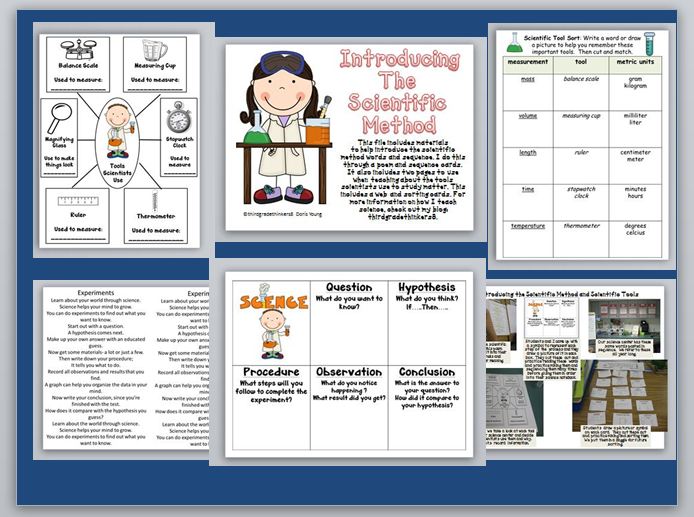
Teaching the Scientific Process and Tools Scientists Use


I love teaching science and find the kids love it too. I wish I had more time in my day to devote to it but there is so much to cover. Here is the science area of my room.  I have the scientific method posted.  These are hard words for third graders but ones they are accountable for in third grade.
We refer to this flow chart all year long!
Our science tools and materials are located here and students enjoy spending time in this area.  I will run a science observation station as part of my literacy rotations.  Students head here to conduct mini investigations, get opportunities to use science tools or can read science books related to the science topics we cover.
 Here is a great read aloud chapter book that helps launch the unit.  It is about a boy who loves science and enters a science fair.  Students relate to this character and my kids really enjoyed this one.  There is a whole series of Owen Foote books so now my students are reading the other ones for independent reading time.  I love when that happens!
Another way I get students to become more comfortable reading and understanding the scientific process vocabulary words is through a poem called, Experiments.  This poem includes all these words and explains them in a rhyming poem. My students glued a copy of the poem into their poetry journal and we highlighted all the key words.  Then they worked on illustrating the poem for meaning.
Check out the great illustrations and words this student added.  I can really tell that he has a pretty good understanding of some of these words.
Here is what he drew and wrote for hypothesis:
Don't you LOVE this:  A brain before and after experiments.
The next day we visited the science area and I introduced each science tool there. We discussed how it is used and what it measures.  Students recorded the information on this web.  It was stapled into their science folder.
The next step extended this thinking a bit more.  Together we created sorting cards for students to practice the tool, the use, and the unit.  We filled these out as a whole class with me leading.  Then they cut them and practiced mixing and sorting the cards.  We keep these in a baggie so it can be done again and again. 
We've played memory match and even go fish with this set of cards.  My advice is to copy them on cardstock so they hold up through the year.  The learning comes from the sorting so we don't glue them down until the very end of the year.

If you are interested in downloading a set of these materials, visit this page on TPT:

http://www.teacherspayteachers.com/Product/Teaching-the-Scientific-Process-and-Science-Tools

 
Check back for a post about our first science unit on Matter!