Wednesday, July 24, 2013

Slapping Syllables: Decoding Multi-Syllabic Words

 
Right...and by third grade there is much installing to do! The bar has been raised once again and  teachers across the state of Virginia, as well as our common core teacher friends, are trying to figure out how to best support students as they are expected to read and comprehend more complex and difficult texts.

I recently read this book by the team of Douglas Fisher,  Nancy Frey and Diane Lapp. I appreciate the way these researchers tackle difficult educational issues and then lead us to practical solutions.  They make some interesting and well founded points regarding text complexity.  Through this book, the authors discuss what exactly makes a text complex and then suggest ways to help students navigate through these more challenging reading tasks.

 
So we know that reading involves multiple cognitive tasks and it requires SO much more than just reading the words on the page. Yet, that is where our readers must start.
 Decoding is a prerequisite skill that can and must be taught in these early grades. Being able to decode words easily and efficiently will help our readers  free their brains, allowing them to focus on the complex thinking involved in understanding difficult texts.
 
My plan is always to introduce key decoding strategies early on in the third grade year so that I can then work on coaching them as they attempt to use these as they read during guided reading sessions. In third grade, students are exposed to many multi-syllabic words. When faced with this decoding challenge, one of the best strategies to use is chunking or breaking  words into smaller syllable parts.
 
This year, I am going to introduce this idea with the song, "Big Word - You Don't Bother Me!" This is sung to the tune of "Shoo Fly -Don't Bother Me!"
Third graders are assessed on their ability to determine number of syllables.
We will practice breaking multi-syllabic words by slapping the syllables with fly swatters as we count them. You can find fun flyswatters at a dollar store.


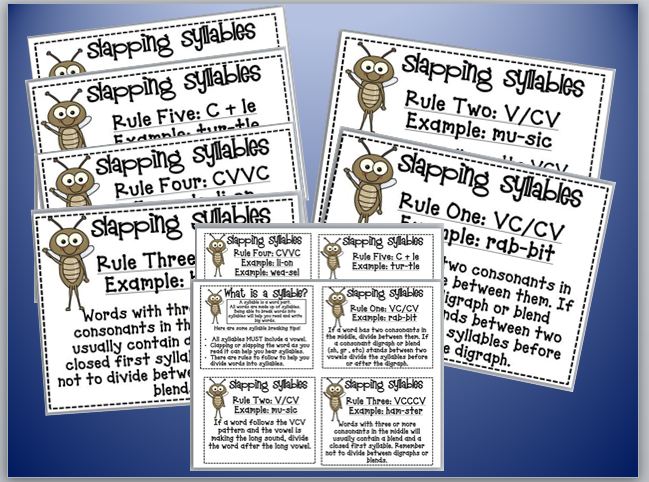
 I will also expose them to syllable breaking rules or patterns during minilessons.  Students will glue rules into our reading journals and they will record examples that we find in the books we are reading.
 
 
I'll keep these patterns posted so that we can refer to them as we read.
 
Finally, we will play games that will give students opportunities to apply these rules and practice breaking words in a fun way.
 
 
I'm including this set in my TPT store.  You can check it out here:
 
 
How are you preparing for the challenge of increased reading rigor?
Would LOVE to hear from you!
Email me!


Monday, July 15, 2013

Words for the Week


Where do you go for your tune up?
  I used to spend entire summers in the Catskills of New York and always felt a sense of peace and contentment there.
I headed to the Blue Ridge in Virginia this weekend.
It does wonders for my soul.

Friday, July 12, 2013

Mastering the Addition Facts: Be a Fact Blaster


Hello Friends! Yes, I am finally finding time to devote to a post. Wow, time just flew by!  I appreciate the emails from my concerned friends who thought I drifted off to sea! I have been on beach mode since my trip a week ago and honestly had trouble getting back into the swing of things.

I missed a couple of weeks of Sunday's Words but these are the ones on my mind lately. The ocean has a way of sweeping away my burdens.
Hope you all are lightening your loads and giving yourself some rest.


        We are finishing up our final weeks of the Marzano's Reflective Teacher book study.   We are working on applying some of the effective teaching strategies as we consider ways to improve our instruction next year.  One area that I am working on is figuring out a way to help my third graders master the addition facts. Students still come to third grade counting on fingers which slows them down in a major way.  I really don't have the instructional time to devote to long practice sessions yet we all know the importance of knowing these foundational facts.

So....here is my new attempt at a plan.  We worked on creating materials with Marzano's Design Questions in Mind. 


Question: What will I do to deepen student's understanding of knowledge?

 First and foremost we wanted our approach to be more about math thinking than math memorization. We will focus on strategies like having students learn the doubles and then teaching them doubles plus one facts.  We will teach students the easy tens and then relate those to the nifty nines. After each strategy is introduced we will hand students the flash cards that correspond to it.  Students will write the sums on the back. Following the strategy facts all that is left would be 5 trickster cards.  We will work on the idea of the comutative property and the identity property throughout our lessons.
 
Question: What will I do to engage students ?
That's an easy one...games, games and more games.  We picked six EASY to play card games and created playing cards so each student can have a pack to take home to play with parents or family members.  This will give them fun practice in applying the strategies.  I discourage finger counting during these game sessions. I spend time walking, talking and coaching while students play these games.  I want to hear and see the math thinking.  I have even taken anecdotal records as a way to assess student progress and to determine if more teaching or just more practice is needed.


Question: What will I do to help students effectively interact with new knowledge?
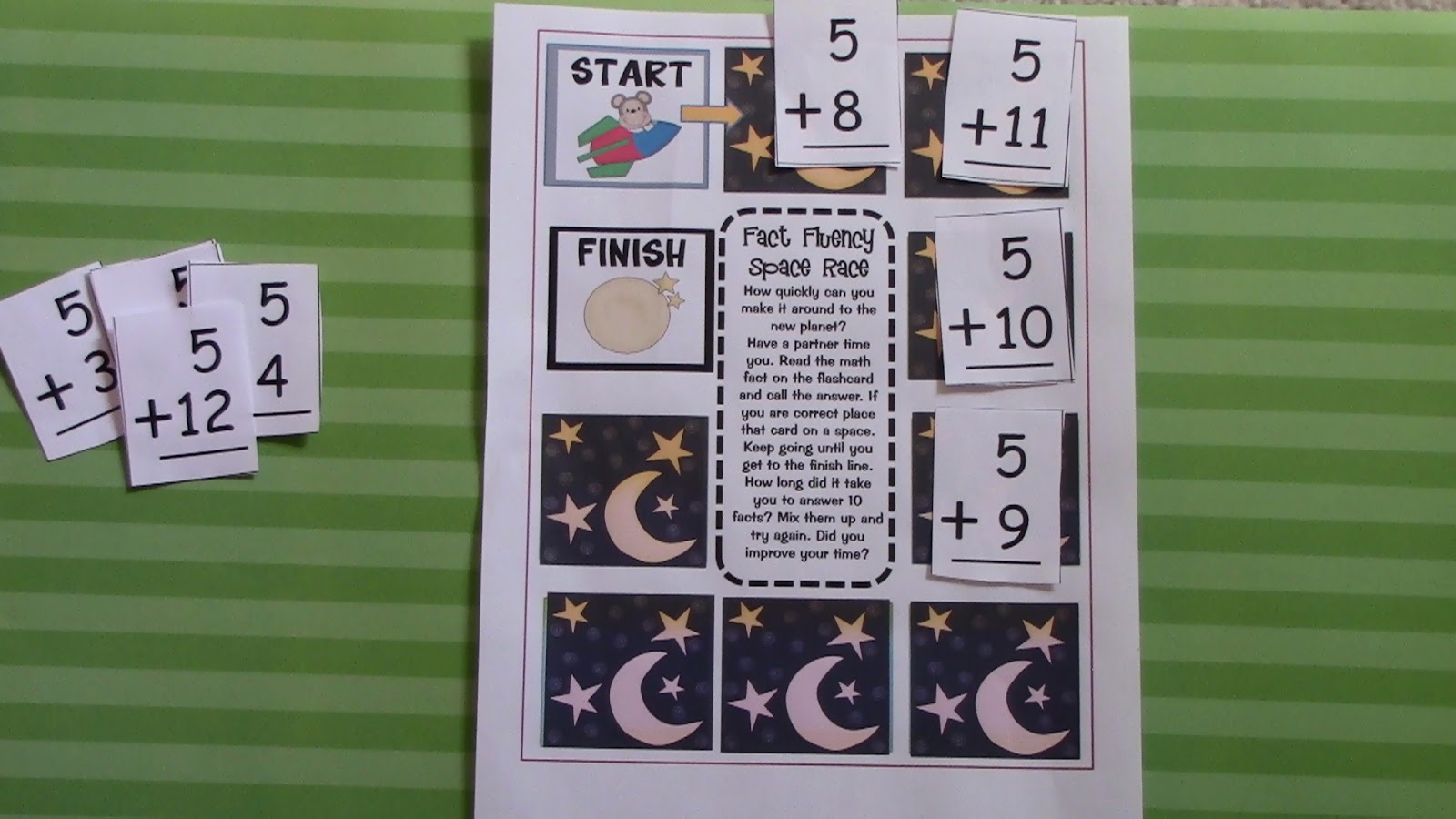
After students have worked on understanding the strategies we will work on our speed with these facts. Here is another interaction activity but this time we stepped it up a bit and students race the clock to see how quickly they can recall the sums.  This has them  racing the clock multiple times to improve their score. I like that this is an individualized competition and they are not racing against another person. Timed practice sessions help students become more comfortable with the weekly timed quizzes and we all know that a relaxed brain performs at a higher level than a stressed out one!
 
 
Question: What will I do to establish and communicate learning goals, track student progress and celebrate success?
 
In our county we are required to give timed addition quizzes.  The third grade goal is thirty facts in one minute.  After each quiz students will plot their number correct on a fact blaster graph and fill out a progress report that will go home for parent review. When we first start this program we ask for parent help and involvement. Part of our homework is to work on these facts either by using the flashcards, card games or the list of online games we give out.  The focus here is on PROGRESS so as long as their graph is going UP we have something to celebrate.  Students will be given a star to place on their sticker chart and a starburst candy to enjoy.  If no progress is made then additional practice sessions at home and at school will be necessary.  

 
I am adding this set to my Teachers Pay Teachers Store so you can head there if you are interested in trying this out.


Now I'd love to hear from my readers!  Please share your ideas on helping students master these very important foundational facts!


T

Saturday, June 29, 2013

Reflecting on Rigor


During our study of Robert Marzano's book, The Reflective Teacher, my book group has come to this same conclusion. I have been loving my sessions with these teachers.  We are not only having awesome discussion, we are eating amazing food like this:


Jeanette brought it and we all devoured it.  You can find this recipe plus many other great ones at Mel's Kitchen Cafe.  Check it out here:

In between bites we talked about that four letter R word.....

We talked about how a rigorous curriculum doesn't need to feel severe, strict or harsh.  Although the dictionary definition leaves us with a negative feeling, a rigorous curriculum can be seen as a positive instructional move.   Having a common vision of high expectations for all students is a good thing. Who wouldn't want that?

We talked about the need to start our planning with the end in mind. Do you do that?   In other words we think it is important to clarify the standard plus the level of understanding that is expected of our students before we can even think about designing an effective lesson. We can no longer spend time on activities just because we think they are good; we need to consider whether or not they are relevant and will get our students to the goal that has been set.  Have you changed your approach to lesson design with the onset of a more rigorous curriculum?  I'd love to hear from you!

More now than ever in my teaching career, students are expected to think in complex ways, to analyze, create and evaluate. This can make an elementary classroom  an exciting place for both students and teachers to work. I am so lucky to be teaching in a county that supports teacher initiative and growth. So I'm excited to start putting into practice some of the ideas our group has been discussing. My book group and I will be tackling the creative problem solving portion of our reflection and will be planning for implementation next.   Our minds are full of ideas on how to use Marzano's instructional delivery model in our teaching.  But for now I'm off to the beach for a few days.....


Will be back soon to share some of our lesson ideas next week.
-Doris

Monday, June 24, 2013

Sunday's Words for the Week


Were you able to catch sight of the super moon this weekend? 
So gorgeous... I was in awe.
 God never fails to impress me.
I'm making a point of using this summer to slow things down and appreciate the beauty and splendor of the world that we sometimes take for granted.

Check out these astronomical events yet to come...


Monday, June 17, 2013

Making Mistakes and Teacher Growth

 
Ha..thought I'd open this post with a bit of humor since making mistakes isn't something we usually laugh about.
 
 
In my class we say, "There is no shame in a mistake." Actually I don't think there is any better way to learn.  I want my students to be risk takers and to not fear being wrong. I was recently reading a book that suggested we should deliberately place complex tasks in front of students to add a component of struggle. It is through the struggle that perseverance is fostered and deep learning is developed. Isn't that what we want for our students?
I think we need to be fair in our approach so students are not bombarded daily with tasks at their frustration level but challenge is good and worthwhile.  

 
So let's shift the thinking on that from students to teachers.  I'm doing an in depth reading of Marzano's The Reflective Teacher with a group of dynamic teachers. These veteran teachers have all been teaching awhile yet all want to get better at what they do and are not fearful about making mistakes along the way. I love that.
 
In chapter one we discussed Marzano's thoughts on the concept of deliberate practice. In deliberate practice teachers continuously strive to achieve mastery of increasingly higher levels of performance. In order to achieve this  individuals must focus on the "not-yet-attained" and challenging tasks that define a superior level of performance. Marzano states that "In attempting these tasks teachers who engage in deliberate practice often fail."  He quotes Rathunde and Whalen  on this idea, "Unless a person wants to pursue the difficult path that leads to the development of talent, neither innate potential nor all the knowledge in the world will suffice."
 
 Marzano writes about the ALACT model of reflective practice.  It stands for action, looking back, awareness, create alternative methods, trial. Teachers use this sequence as they attempt to build their skill in a particular area of their teaching. The cycle continues until they meet with a high level of success.
 
So are you ready for the challenge and prepared for the possibility of failure? My group talked about how our new teacher evaluation system could possibly prevent teachers from wanting to disclose the negatives in their teaching experiences yet Marzano suggests "making  practices transparent and  knowledge public in the presence of others" is necessary for teacher growth.
 
So let's put aside teacher ratings and not be hesitant to share and support each other as we grow in our profession.
Is there an area you are going to deliberately practice? I know there are many for me and will be back later to post on those. 
Would love to hear your thoughts on this topic!
 
email @youngdor8@gmail.com